



Rwanda seeks to keep mercury out of gold mining as illegal operations pose monitoring challenge
 Uwimanimpaye Cyiza Marie ClemenceSeptember 10, 20265 Mins read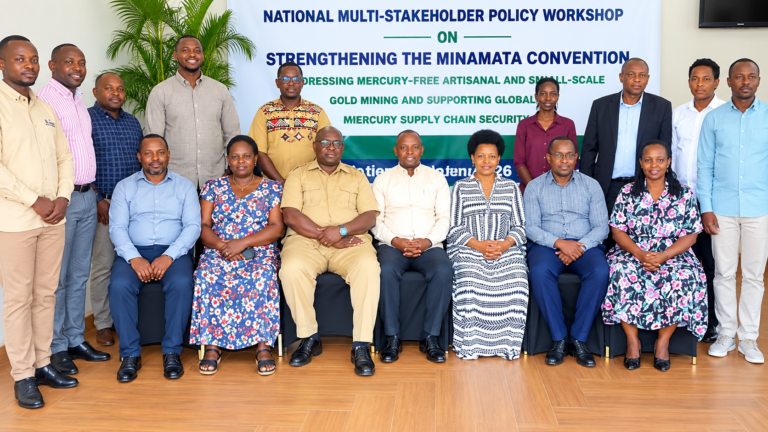
Rwanda has made significant progress in keeping mercury out of artisanal and small-scale gold mining, but gaps in legislation and monitoring could make it harder to ensure that the toxic metal does not return to the sector, officials and environmental groups said.
The issue was discussed at a national policy workshop in Kigali on Sept. 8, organised by ARECO-RWANDA NZIZA in partnership with the International Pollutants Elimination Network (IPEN), bringing together representatives of government institutions, mining companies, health agencies, civil society, academia and the media.
A national assessment conducted under Rwanda’s 2023 National Action Plan found no evidence of mercury use across the surveyed active artisanal and small-scale gold mining sites, according to the Rwanda Environment Management Authority (REMA).
The finding highlights Rwanda’s progress in moving towards mercury-free gold processing. But the workshop also underscored a more difficult question: how can the country make sure that progress is maintained across a sector where some mining activities can be difficult for authorities to trace and monitor?
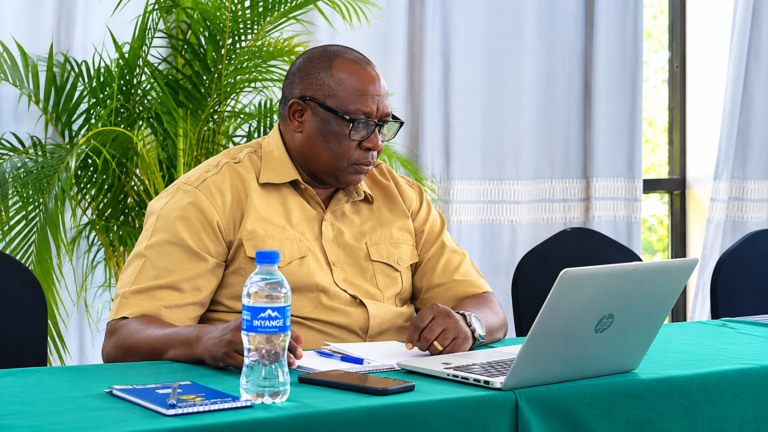
For Balthazar Twagilimana, vice president of ARECO-RWANDA NZIZA, Rwanda’s experience gives it a useful position in international discussions on mercury.
“Rwanda can therefore contribute a particularly valuable perspective to the global debate: a perspective based on national experience rather than theory alone,” Twagilimana said in opening remarks.
Rwanda’s progress could nevertheless face regional risks, he said, particularly because mercury remains a concern in gold mining in some neighbouring countries.
“Regional gold and mercury trafficking risks therefore cannot be viewed only as a problem for other countries. They also represent a potential threat to the progress Rwanda has already achieved,” he said.
“We must therefore ask ourselves a critical question: How do we ensure that Rwanda’s mercury-free ASGM sector today remains mercury-free tomorrow?”
Closing a legal gap
One of the main concerns raised at the workshop was the absence of a specific national provision prohibiting the import and use of elemental mercury.
“In fact, one of the most significant challenge is the absence of a specific national legal provision explicitly prohibiting the import and use of elemental mercury,” Twagilimana said.
“Although Rwanda has regulations prohibiting several mercury compounds and has broader environmental controls on hazardous substances, elemental mercury itself is not explicitly addressed in the same way.”
Rwanda already has legislation covering environmental protection, hazardous substances, mining and occupational health and safety. But participants said more specific measures could help prevent elemental mercury from entering the country through illegal channels.
The concern is particularly relevant to artisanal and small-scale mining, where activities outside the formal system can be more difficult to monitor.
The workshop therefore looked beyond the question of whether mercury is currently being used at surveyed sites to the broader issue of how authorities can detect and prevent its reintroduction.
Vincent Karemera of ARECO-RWANDA NZIZA said the organisation had convened the meeting to strengthen cooperation and public understanding around mercury.
“We organised this meeting so that we could complement each other in strengthening our efforts, so that we can reduce and even remove this chemical from the market or from everyday activities in which it is used, so that people can know about it and also avoid using it as a harmful and dangerous chemical,” Karemera said.
“It is in that context that we organised this meeting, so that we can implement what is provided for in the convention that the country signed, and so that we can also contribute our support to the implementation of this convention.”
Health risks
The health dimension was also a central part of the discussions.
A representative of the World Health Organization explained the harmful effects of mercury on human health and the different pathways through which people can be exposed to it.
The form of mercury matters. People can be exposed to elemental mercury mainly by inhaling its vapour, while other forms can enter the body through ingestion or skin contact. Methylmercury is a particular concern because it can accumulate in fish and shellfish and reach people through contaminated food. Mercury exposure can also occur in workplaces and when mercury-containing products break or are improperly handled.
Mercury can affect the nervous, digestive and immune systems, as well as the lungs, kidneys, skin and eyes. It poses a particular risk to the developing nervous system of unborn children and young children.
In aquatic environments, mercury can be converted into methylmercury, which accumulates in aquatic organisms and can become more concentrated as it moves through food chains.
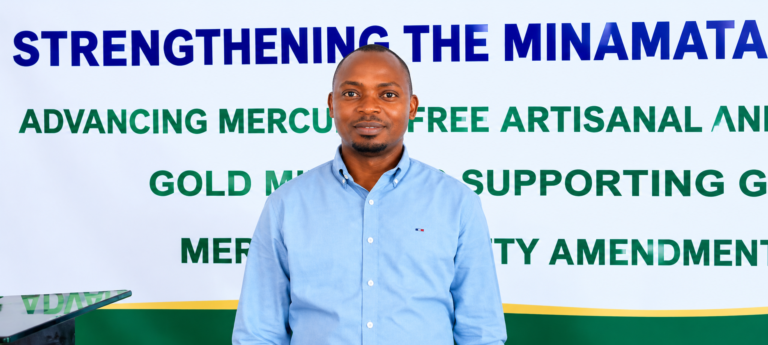
Ngirabakunzi Octavien, an official representing REMA, called for stronger cooperation among institutions involved in addressing mercury pollution and for targeted public awareness campaigns on its health and environmental risks.
He said REMA was ready to work with other institutions towards building “a mercury-free Rwanda.”
The discussions also highlighted practical challenges facing Rwanda’s mercury management system, including limited capacity to monitor mercury in water, soil, waste and air.
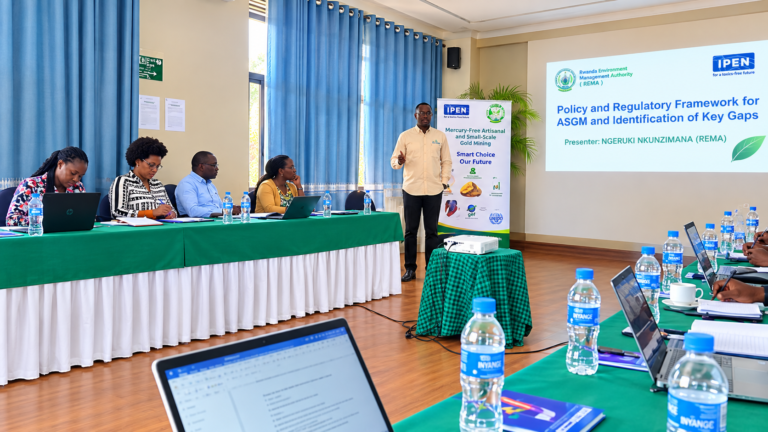
Participants pointed to the need for better information about artisanal and small-scale gold mining activities and the quantities of mercury that could potentially enter the country or be used outside monitored operations.
Access to mercury-free technology can also be difficult for some small-scale miners because of financial constraints, while some miners require additional technical training to use alternative gold-processing methods.
Health monitoring was another concern, particularly for miners and communities living near mining areas.
Taking the message to communities
For Bugingo Emmanuel, founder of the Rwandan organisation Partners for Conservation, the workshop provided an opportunity to learn more about an international agreement that he said remains unfamiliar to many people even though mercury has historically been part of everyday life.
“It is a convention that I would say many people do not really know about, yet in reality they live alongside it,” Bugingo said.
“Although mercury is no longer as visible as it was in the past, there is no one who has not used a medicine called Mercurochrome, and there is no one who has not seen the instrument used to measure a person’s body temperature, which was placed under the armpit, the thermometer, and various other things.”
Bugingo said the meeting had also given him information that he could take back to communities his organisation works with.
“As someone who came to this meeting, the first thing I learned was what is required. I learned about the challenges that exist, I learned what is required,” he said.
“What I am going to do is that, since we work with different communities, I will try to talk to the people we work with, especially telling them that other steps have already begun to be taken to address this chemical.”
Keeping the gains
Ngirabakunzi Octavien from REMA said mercury should not be viewed in isolation from other problems affecting Rwanda’s mining sector.
He cautioned against treating mercury-free mining as the only priority, pointing instead to mine safety, occupational health, pollution, exposure to silica dust and inadequate protective equipment as other concerns requiring attention.
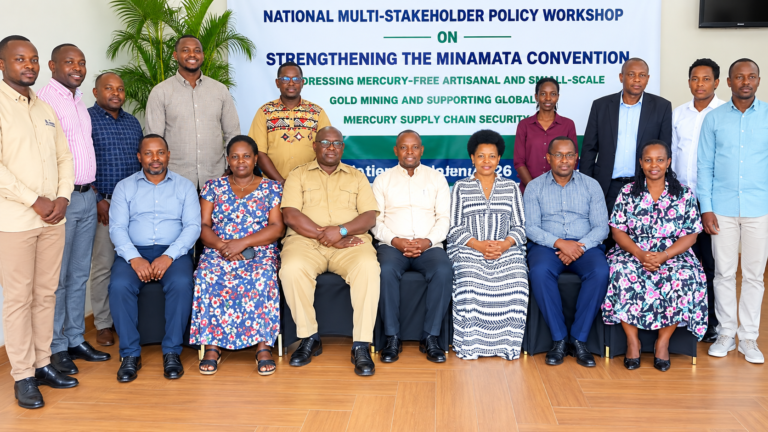
That broader approach is important because eliminating mercury does not by itself make mining environmentally or occupationally safe.
For Rwanda, however, maintaining the progress already recorded on mercury remains a central concern.
“Our responsibility now is to protect that progress, close the remaining gaps, and ensure that the country does not become vulnerable to mercury use in the future,” Ngirabakunzi said.
The workshop also considered two proposed amendments to the Minamata Convention backed by IPEN and the U.N. Special Rapporteur on Human Rights and Toxics: ending legal international trade in mercury except for environmentally sound storage and disposal, and establishing 2032 as a legally binding global deadline for phasing out mercury use in artisanal and small-scale gold mining.
Rwanda has been a Party to the Minamata Convention since 2017 and developed a National Action Plan for artisanal and small-scale gold mining as part of its efforts to implement the treaty.
For Rwanda, the discussions are therefore as much about protecting a national achievement as contributing to a wider international effort.
The country’s surveyed mining sites have demonstrated that gold can be processed without mercury. The remaining challenge is to strengthen legislation, monitoring, enforcement and regional cooperation so that progress is not undermined by mercury entering through channels that are harder to see.
Photo credits: Alex Rukundo


Related Articles
From food waste to business: Rwanda’s CIRF project looks beyond five years
Rwanda is seeking to build on lessons from a five-year programme that...
Uwimanimpaye Cyiza Marie ClemenceSeptember 6, 2026 
Kwita Izina puts Rwanda’s conservation model under the environmental spotlight
The naming of 22 baby mountain gorillas in Rwanda this week was...
Uwimanimpaye Cyiza Marie ClemenceSeptember 6, 2026 
Rwanda energy conference to seek investment, regional partnerships as Africa transition accelerates
Rwanda will host the sixth Renewable Energy for Sustainable Growth (RE4SG) Conference...
Uwimanimpaye Cyiza Marie ClemenceSeptember 6, 2026 

Rwanda Braces for Drier September as Temperatures Expected to Rise Slightly
Rwanda is expected to experience generally dry weather conditions throughout September, with...
Uwimanimpaye Cyiza Marie ClemenceSeptember 1, 2026
Leave a comment