




Global temperatures likely to remain at record levels through 2030, WMO says
 Uwimanimpaye Cyiza Marie ClemenceJune 1, 20261 Mins read
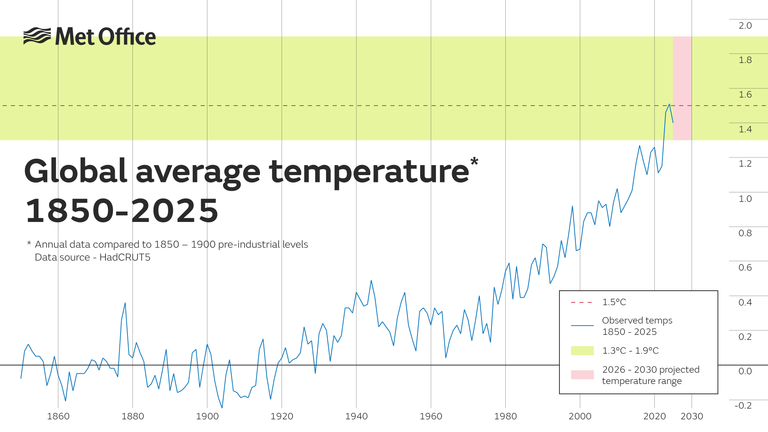
Global temperatures are expected to remain at or near record highs over the next five years, with a high probability that the world will experience another warmest year on record before the end of the decade, according to a new forecast released by the World Meteorological Organization (WMO) and the UK Met Office.
The assessment estimates an 86% chance that at least one year between 2026 and 2030 will surpass 2024 as the hottest year since modern records began.
Annual global temperatures during the period are forecast to range between 1.3°C and 1.9°C above pre-industrial levels, reflecting the continued impact of human-induced climate change.
Scientists also project a 91% likelihood that at least one year in the next five years will temporarily exceed 1.5°C above the 1850-1900 average. However, the WMO stressed that this would not constitute a breach of the Paris Agreement, whose temperature targets are measured over long-term averages rather than individual years.
The report also found a 75% chance that the average temperature across the entire 2026-2030 period will exceed 1.5°C above pre-industrial levels. At the same time, the likelihood of any single year surpassing 2°C of warming remains below 1%.
Researchers said a developing El Niño event later in 2026 could further increase global temperatures, raising the possibility that 2027 may emerge as the next record-breaking year.
Beyond global averages, the forecast highlights accelerating warming in the Arctic, where winter temperatures are expected to rise roughly 2.8°C above the 1991-2020 average during the next five northern hemisphere winters. The report also points to continued declines in Arctic sea ice, particularly in the Barents Sea, Bering Sea and Sea of Okhotsk.
The assessment projects notable shifts in rainfall patterns as well. Wetter-than-average conditions are expected across northern high-latitude regions, including parts of northern Europe, Alaska and Siberia, while drier conditions are forecast for some subtropical areas and parts of the Amazon basin.
According to the WMO, the projections reinforce longstanding scientific warnings that even small increases in global temperatures can heighten the risk of extreme weather events, disrupt ecosystems and reduce the ability of communities to adapt to climate change.
The forecast was compiled by the Met Office in its role as the WMO Lead Centre for Annual to Decadal Climate Prediction and incorporates contributions from 13 international climate prediction institutes.




Related Articles
Permagardens offer a new start for drought-hit families in coastal Kenya
By Afia Agyapomaa Ofosu MBUGUNI, Kenya – For families in Mbuguni, a...
Uwimanimpaye Cyiza Marie ClemenceOctober 8, 2026 
Rwanda and Senegal deepen economic ties, with agriculture and standards in focus
KIGALI, Oct. 8, 2026 – Rwanda and Senegal have signed 11 agreements...
Uwimanimpaye Cyiza Marie ClemenceOctober 8, 2026 
ACE4Food: Helping Rwanda’s agri-food SMEs turn circular ideas into business opportunities
For Kayitesi Grace, circular economy is not a concept she only heard...
Uwimanimpaye Cyiza Marie ClemenceSeptember 25, 2026 

REMAPSEN: Building a bridge between health, environmental information and African communities
When a disease begins to spread, a water source becomes contaminated or...
Uwimanimpaye Cyiza Marie ClemenceSeptember 25, 2026
Leave a comment