



Global Agri & Food Safety Congress 2026: Building Resilient Food Systems in a Changing Climate
 Uwimanimpaye Cyiza Marie ClemenceFebruary 16, 20264 Mins read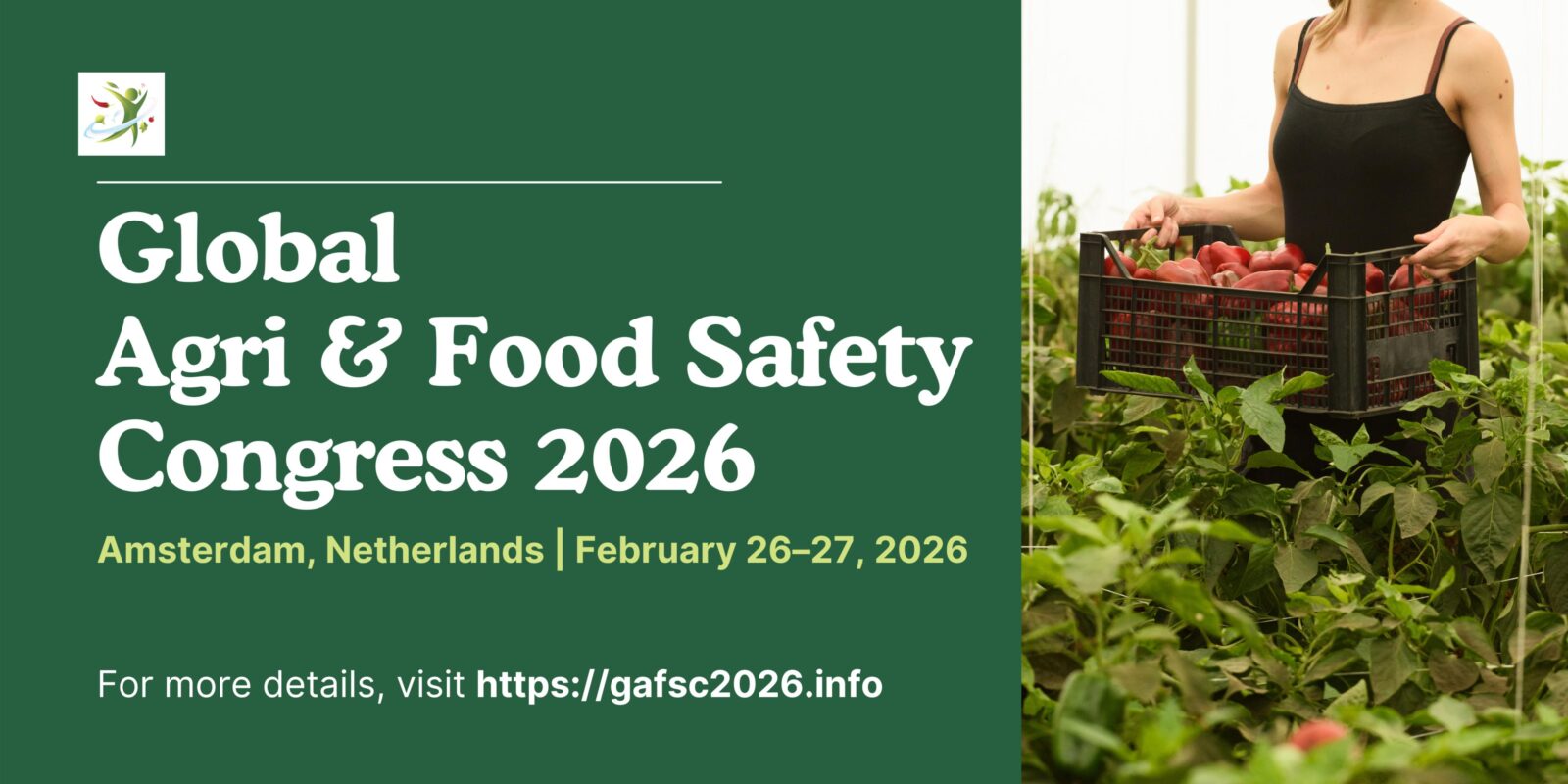
On 26–27 February 2026, international experts, researchers, industry leaders, farmers, and policymakers will gather in the Netherlands for the Global Agri & Food Safety Congress 2026; a timely forum dedicated to strengthening food safety, sustainability, and agricultural resilience in a world facing mounting environmental and economic pressures.
A Growing Global Focus on Agrifood Systems
In recent years, the agrifood sector has taken on greater prominence in global discussions; not just as an economic activity, but as a central piece of food security, climate resilience, public health, and sustainable development. Efforts to transform food systems toward more sustainable and safe pathways are gathering momentum, with governments, research institutions, international organizations, and industry leaders recognizing that meaningful change requires broad cooperation and innovative thinking.
The Global Agri & Food Safety Congress 2026 enters this landscape at a pivotal moment. It offers a dedicated space where cutting-edge science, practical realities, and emerging solutions can come together to address some of the most complex challenges facing agriculture and food systems today.
A Sector Under Pressure
Agriculture today faces unprecedented complexity. Climate variability, soil degradation, production instability, economic pressures, and evolving regulatory frameworks are reshaping how food is grown and safeguarded.
Among the speakers contributing to this important conversation are Filip Van Noort a researcher (crop specialist) of Wageningen University & Research and Dr. Sanem Argin, co-founder and CEO of Kiana Agriculture, working closely with farmers and agricultural systems. Their insights reflect both scientific depth and practical urgency.
Climate Change and the New Reality of Crop Production
For Filip, participation in the Congress stems from a growing pattern he observes in his academic and advisory work: plants are no longer behaving as they once did.
“Because of climate change, plants are behaving differently than before,” he explained. Shifting weather and wind patterns are affecting open-field cultivation worldwide. Crops now face conditions that are too dry, too wet, too hot, or too cold; sometimes within the same season. Farmers encounter fluctuations that delay harvests, increase disease pressure, and complicate post-harvest handling.

These agronomic challenges are often compounded by economic realities. Many growers operate with limited financial capacity, restricting their ability to invest in adaptation strategies. Filip identifies three critical gaps: lack of financial resources, lack of technical knowledge, and lack of well-adapted plant material for new climate conditions.
One potential pathway forward is more protected cultivation. While not feasible for all crops, protected systems can stabilize production, enhance quality, support integrated pest management, promote water and fertilizer reuse, and reduce land pressure. However, scaling such systems requires coordinated research, investment, and practical education.
“Government, growers, research, and education should work together,” he emphasized. “We should listen to each other.”
Productivity, Sustainability, and Trust in Innovation
From her direct engagement with farmers, Dr. Argin observes a shared concern: many continue using established practices, yet yields are declining.
Two major drivers underpin this trend. The first is deteriorating soil health, often linked to long-term chemical input overuse and climate stress. The second is climate-related instability, including temperature anomalies and changes in light intensity that directly affect plant physiology.
At the same time, farmers are under pressure to reduce chemical inputs while maintaining productivity and ensuring food safety. Rising costs and regulatory demands further complicate decision-making. Adding to this complexity is the spread of misinformation; claims about “natural” or “sustainable” solutions that lack rigorous scientific validation.
Dr. Argin challenges the assumption that productivity and sustainability are opposing goals.
“Productivity, food safety, production costs, and environmental performance are not competing objectives,” she explained. “They are interconnected outcomes of healthy agricultural ecosystems.”

Bio-based inputs such as biostimulants and bio-based fertilizers can help rebuild soil biology and enhance resilience when integrated gradually within a systems approach. Data-driven decision tools and climate-informed practices further reduce uncertainty by improving timing, monitoring, and risk assessment.
Sustainable transformation, she stresses, must be science-driven, field-validated, and scalable under real-world conditions.
Building Cooperation Across the Agrifood Value Chain
Both Filip and Dr. Argin emphasize that long-term cooperation among stakeholders is essential for lasting progress. This includes strengthened partnerships among researchers, growers, industry innovators, and policymakers; all working together to ensure that scientific insights are translated into practical action that benefits farmers, consumers, and communities alike.
In this broader context, the Global Agri & Food Safety Congress 2026 serves as a platform where these diverse voices can meet, exchange ideas, and co-create solutions for the future; not as an endpoint, but as a catalyst for collaboration that continues beyond the two days of the event.
Who Should Attend and How to Register
The Congress welcomes agricultural scientists, farmers, agronomists, food safety professionals, researchers, policymakers, industry stakeholders, and students interested in advancing resilient food systems.
Registration is available online via the official Congress website, with tiered pricing based on participant category and registration period.
Registration Options
•Early Bird (until 31 August 2025) – Lower rates for speakers, delegates, poster presenters, and students.
•Standard (until 16 February 2026) – Regular registration fees.
•On-Spot (from 26 February 2026) – On-site registration available at the venue.
Additional options include an accompanying person pass and exhibitor packages. Accommodation packages are also available for attendees wishing to stay at the conference hotel.
Looking Ahead
In an era where agricultural systems are under mounting pressure, dialogue alone is not enough. The real measure of success lies in translating scientific insight into practical, scalable solutions that protect both food safety and farmer livelihoods.
On 26–27 February 2026, at the Park Plaza Amsterdam Airport Melbournestraat 1, 1175 RM Lijnden, Netherlands; the global agri-food community will gather not only to exchange ideas; but to help shape the next chapter of resilient agriculture.
For more info, you can visit the Congress website by clicking here

Related Articles
“Unsafe Meat Can Lead to Zoonotic Diseases,”- Dr. Gaspard Simbarikure
In Burera District, a visit to a modern poultry processing facility reveals...
Uwimanimpaye Cyiza Marie ClemenceMarch 24, 2026 
VIBE Campaign Launches to Boost Food Quality and Job Creation in Rwanda
The Government of Rwanda has officially launched a nationwide awareness campaign under...
Uwimanimpaye Cyiza Marie ClemenceMarch 23, 2026 
10 Takeaways from Ghana’s Science Media Training
By Afia Agyapomaa Ofosu For many journalists, covering science can feel intimidating....
Uwimanimpaye Cyiza Marie ClemenceMarch 21, 2026 

Turning Climate Commitments into Action: Voices from Rwanda on the Environment and Climate Change Mainstreaming Strategy
Rwanda has taken another step in strengthening its climate and environmental governance...
Uwimanimpaye Cyiza Marie ClemenceMarch 10, 2026
Leave a comment